
You want AI to cut delivery time
Not just to add more headcount to your invoice.
For founders and CTOs who want AI to actually speed up delivery, not just appear in a sales deck. We tell you which parts of your build AI can safely accelerate, and where you still need a senior engineer, before we charge you for either.


Not just to add more headcount to your invoice.
And you want proof. Every commit can carry its declared AI share, model and tool. The weekly report built from git log shows them, including commits with no measurement.
Now you need to know what's safe to keep before real users touch it.
Answers, document processing or approvals need your records, access rules and a way to check the result.
Process mapping usually takes one to two weeks, and a clickable prototype one to four more. We build it on the structure of a production frontend, so the screens your users approve become the product's frontend instead of a throwaway.
An agent writes each change together with its tests and its documentation page; engineers review it, and QA and product people check how the feature behaves. By day 37 of one consumer build that came to 731 test files and 107 pages of documentation.
Hand an agent a tester's bug report, a failed deployment or a screenshot. It reads the ticket, the code and the logs, finds the cause and drafts the fix, and a developer inspects it before it merges.

AI now builds most of what a demo shows in a small part of the time. The part nobody demos (edge cases, permissions, tests, migrations) is still most of the work, and that is where a senior engineer earns their keep.

Working code is not the same as safe code. Every generated change gets a person who reads it and a security pass on permissions, injected input, secrets and the failure path, before it faces real users and real attackers.

AI handles the happy path well, and production rarely stays on it. We check what happens when a request fails, two users change the same record or someone tries to open another account, and those cases go into the implementation and the tests.

Some decisions are expensive to reverse: the data model, module boundaries, which vendor you lock into. A senior engineer makes those calls and writes them down, so the agents build inside the boundaries instead of around them.
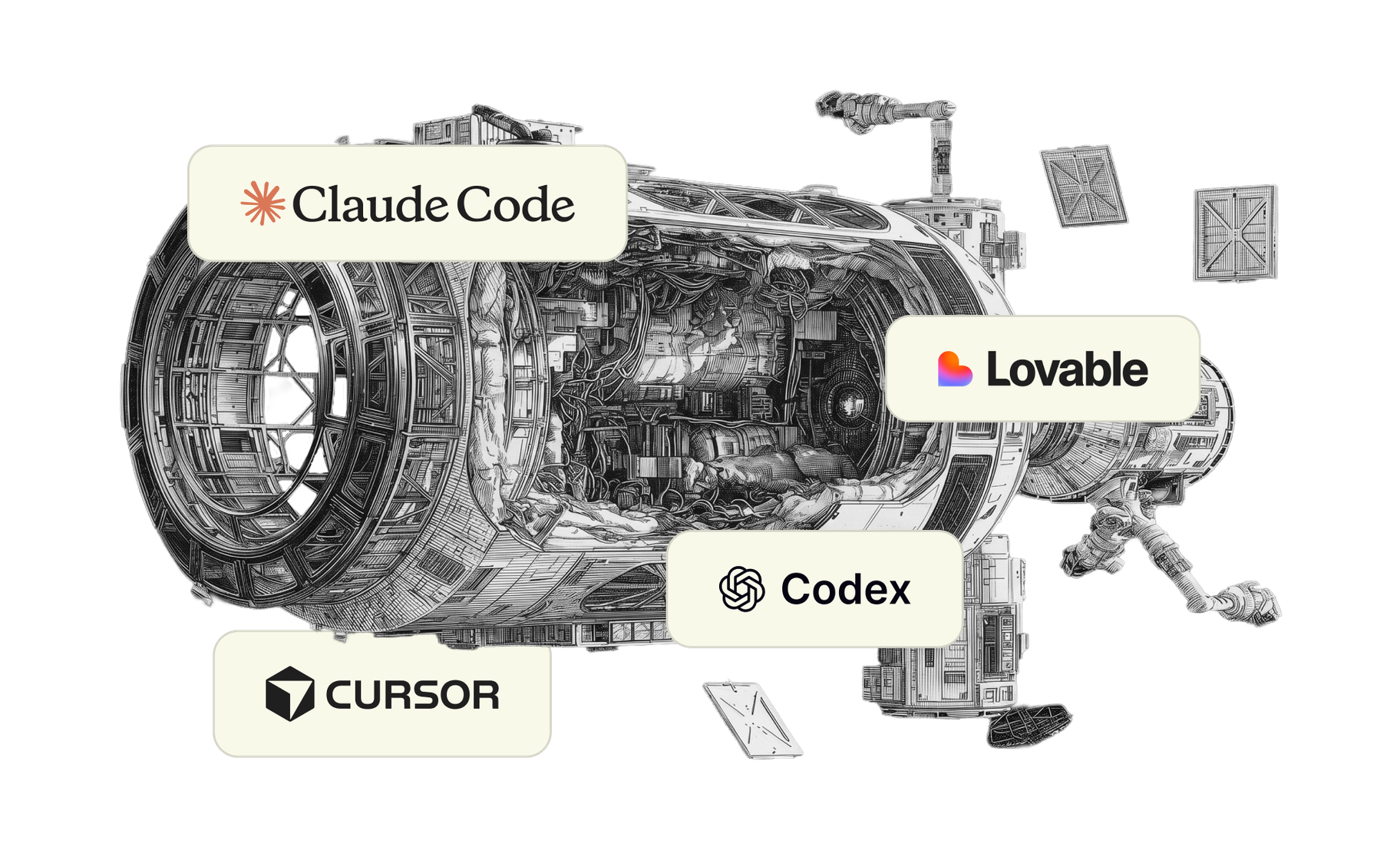
You built a working version with Cursor, Lovable, or Claude Code. It works, mostly.
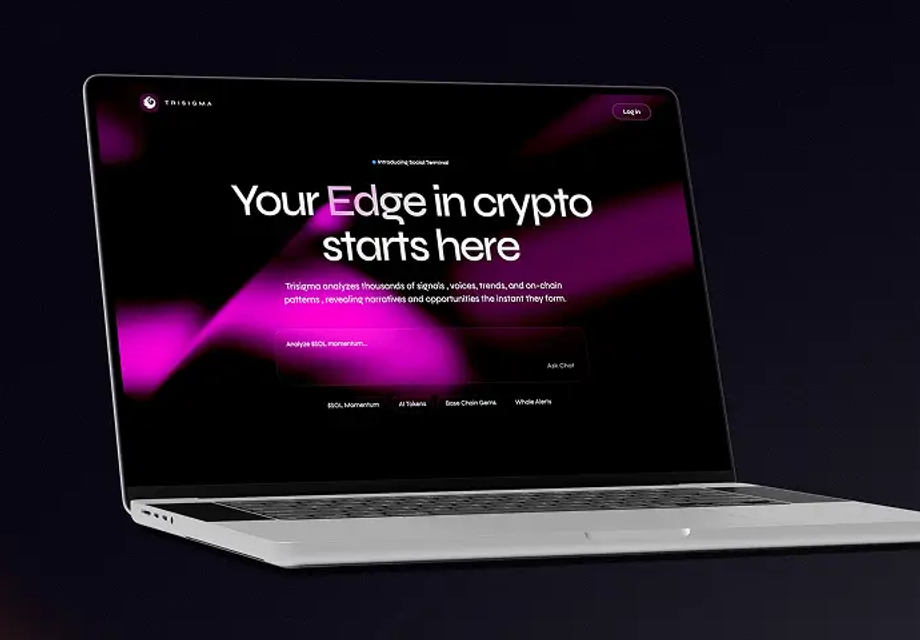
Before you put it in front of paying customers, someone needs to tell you what's solid and what will break under real traffic, real data, and real attackers. Signal Mesh's founders built their crypto market intelligence MVP themselves and validated the idea. Then their only developer left. What remained was the natural result of a product built fast, by one person, to prove a concept: a frontend that needed a full rebuild, ~20 Python microservices with no security hardening, and a database where any logged-in user could read or delete anyone's data.
We inherited that codebase, rebuilt the frontend (React, Vite, TanStack), gave the backend a proper API layer (Fastify), closed the database access controls, and added an AI intelligence layer: a RAG pipeline and semantic search, with three LLMs tested in production (OpenAI, Claude, Grok). Live in 6 months, with a founding user community already testing it.


“Pirxey provides you the full package - you can ask for data experts, you can ask for AI experts, you can ask for frontend experts, and you have everything. The communication was really great - more than that, it was amazing.”
A clickable user journey built on a frontend you can develop into the product. Test it with users before funding the backend and full production work.
Read more: Rapid AI prototypingTest a risky technical assumption on agreed data. You get runnable code, observed results and a recommendation on whether to proceed.
Read more: Proof of concept developmentA focused product build through our AI Software Factory: for a scoped SaaS or internal tool, a first working version in six to eight weeks.
Read more: Fast-track custom developmentTake an app built with Lovable, Bolt, Replit, v0, Cursor or Claude Code live: your domain, real logins, a production database with backups and a deploy you can repeat.
Read more: AI-built app to productionFind why the app breaks under real users and real data, fix the cause in your repo and keep it fixed with tests.
Read more: Fix an AI-built appReview generated code and access controls, then implement and verify the agreed fixes before wider release.
Read more: Security for vibe-coded appsSearch and answers grounded in your data, with retrieval that follows user permissions, test cases for answer quality and visibility into running costs.
Read more: AI integration & RAGAutomate a repeatable workflow across your tools. Use rules for predictable steps, AI to interpret messy input and human approval for the exceptions you define.
Read more: AI process automationEngineering decisions before the build
We identify where AI can help and where a senior engineer needs to take over. Our engineers use tools such as Claude Code, Cursor and Codex. The choice depends on the task.

You’re not getting a classic developer who simply does and then you have to fix the thinking yourself. If I had another AI idea and wanted to pursue it, I would just use Pirxey. It wouldn’t be a question.

A scoping call, then process mapping with your stakeholders: a business analyst and a senior architect work through the business outcome, hard and soft deadlines, users, integrations, data and risks. For a new product this usually takes one to two weeks; for an app you already have, we start by reviewing what exists. You leave with a process blueprint, a prioritized backlog, a written scope and a price range.

We split the scope into what agents can build under review and what needs a senior engineer from day one. You see the split, the estimate for each part and the reasons. Where an assumption is still untested, we scope a user prototype or a technical proof of concept before the larger build.

Code, tests, documentation and acceptance criteria are produced in parallel. An engineer who owns the result reviews every change, and QA and product people check the working feature. When we start from a prototype, its frontend stays. For a scoped SaaS or internal tool, our AI Software Factory offer covers a first working version in six to eight weeks. You get a status daily at first, then weekly once trust is there.

After launch we stay for the measured part: usage, costs of AI calls, what to automate next. Fixed scope or a dedicated squad, your call; your team keeps the code and the operating documentation either way.
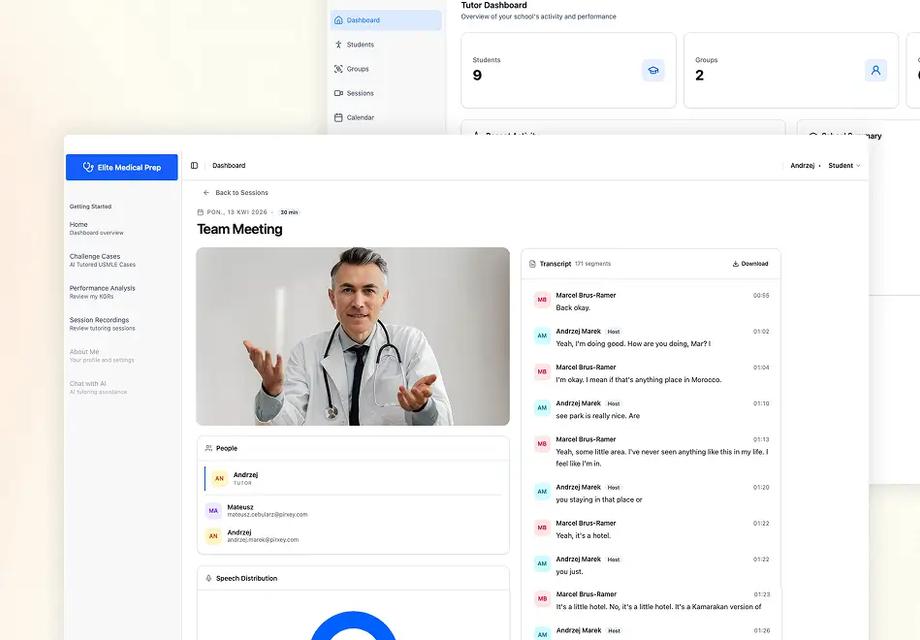


"Pirxey gave us the full package - frontend, backend, AI, and data - all under one roof, which meant we never had to coordinate multiple vendors. They thought like product owners, not contractors."

"What stayed with me was the communication. Fast, clear, and always with something concrete - a proposal, an update, a solution. We never had to wonder what was happening."

"Their ability to quickly deliver high-quality solutions while maintaining transparency in communication is rare."
"When you propose something to them, they don't simply say yes - they come back with a pro and con. You're not getting a classic developer who simply does and then you have to fix the thinking yourself. If I had another AI idea and wanted to pursue it, I would just use Pirxey."

"Well… didn't know what to expect but honestly, now I'm learning much from you guys. Had no idea an external tech partner can be so pro and organized."
"Their ability to quickly deliver high-quality solutions while maintaining transparency in communication is rare."

Our rule is that the client never learns about a problem from a missed deadline. They learn about it from us, with options, while there is still time to choose.
Head of Delivery

Writes the domain model and service boundaries down before features go on top. On our six-week build, the review rules asked the same five scale questions of every change, from bounded queries to a job that arrives twice.
Backend program lead

Starts every interface on a component library and a design system, with accessibility part of done. On WSB Merito that meant WCAG 2.1 AA compliance documented for a ministerial audit.
Frontend program lead

Our AI engineers work the way the rest of the company does. In September, 53 of the 77 people who answered our monthly AI Pulse said an agent runs whole tasks while they set the plan and verify the result.
AI R&D Lead
What actually changes for founders, product teams and CTOs when software is built AI-native, and how to tell a rebuilt process from a faster typist.
Read the article: AI-native software development: what changes for founders, product teams and CTOs?Every commit on a live client project records its AI share, model and tool, so you can see how we use AI before you hire us.
Read the brief: Do you even use AI? The receiptsWhy faster coding alone does not ship your product sooner when discovery, review, security checks and testing still run at human speed.
Read the brief: Your developers got faster. Did your product?Tell us what exists, who will use it and what needs to work next. We reply within one business day and sign an NDA first if you want one.
 Mike KacprowiczBook a callChief Growth Officer


