

Client
The client is a first-time product company entering the U.S. political-campaign-finance software market. Their product serves two user types: political committees running election campaigns, and the advertising agencies those committees hire to run ad spend. The client had no prior product and no in-house engineering team - this was a from-zero build. The engagement started with product design through Widelab,and expanded into full custom development once early workshops made clear the product needed a backend, frontend, and infrastructure built from a blank page - not just a UI.
Challenge
U.S. political committees have historically had one option for funding agency ad spend: wire the money to the agency and hope it gets tracked correctly.
Once an agency holds committee funds directly, oversight gets weak fast - committees lose visibility into what's actually being spent on Meta ads versus Google ads versus anything else, and under U.S. anti-money-laundering rules, moving large sums to third parties triggers exactly the kind of scrutiny a first-time political-tech vendor is least equipped to handle. It's the kind of paid-media chaos political campaigns have quietly tolerated for years - money moving, but no one able to say exactly where it went until well after the fact.
The harder problem wasn't the concept - it was that this was the client's first product ever, and they were still learning what building and running real software actually involves. Early user flows existed only at a high level, without the day-to-day specificity a real backlog needs - who exactly is logged in as which role, in an org structure that stacks committees, campaigns, and agencies on top of each other. The client hadn't yet built the instinct for what "requirements" means at implementation depth, and mid-project additions of new political-advertising stakeholders kept reshaping ground the team thought was already settled. Closing that gap meant actively building the client's own understanding of the process, not just executing what they asked for.
This is exactly where having a dedicated business analyst on the project turned out to be decisive. Once the team's BA dug into the details, she re-workshopped flows down to a level of concreteness the client could never have specified alone - precisely because they'd never done this before. The team is candid that the MVP would not have shipped on time in June without that role in place.
What we built
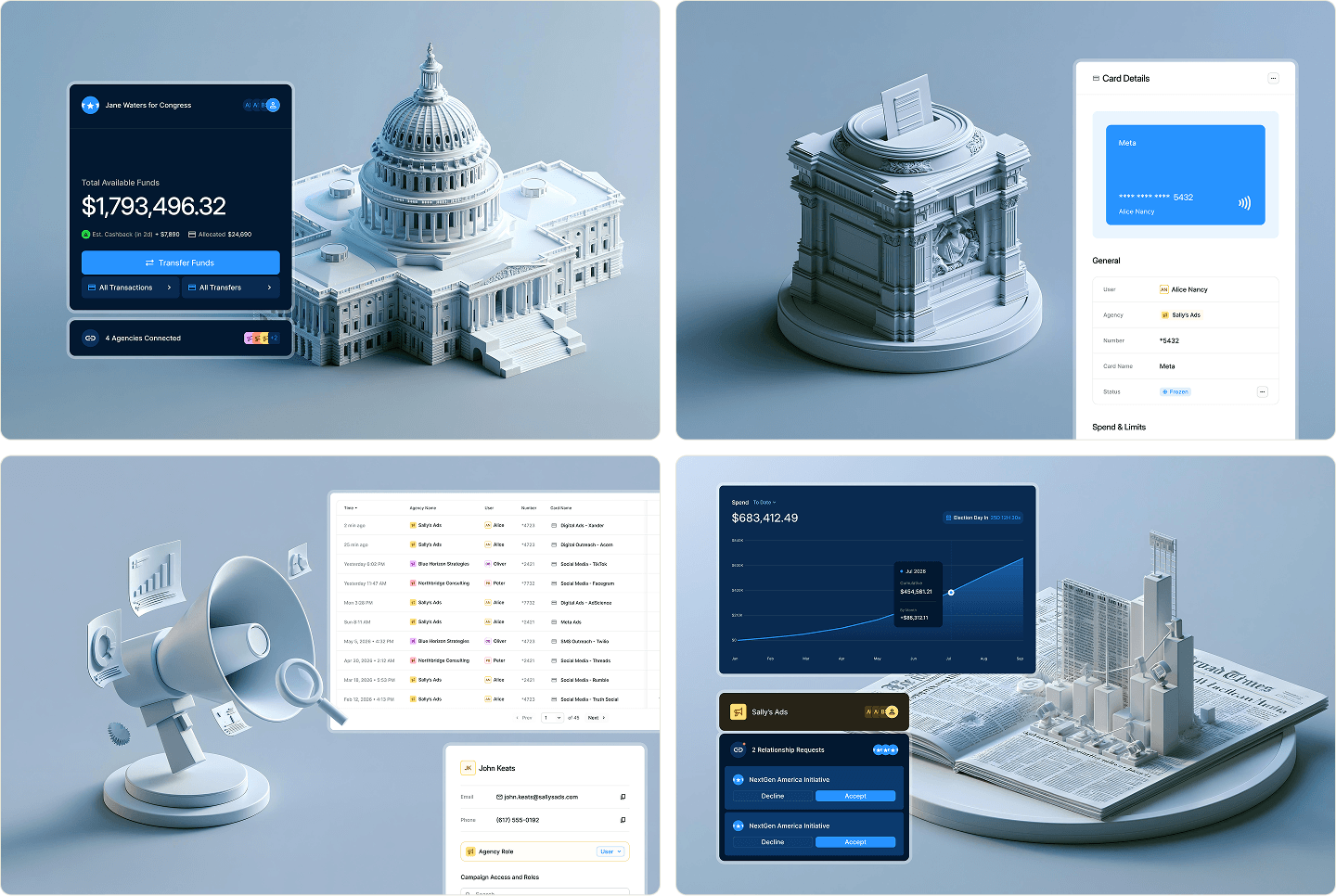
Rather than take the client's fund-transfer model at face value, the team designed the platform around a structural fix: committees fund campaigns, campaigns allocate budget to agencies, but agencies never receive cash to their own account.
Instead, an agency employee requests a virtual card scoped to that campaign's budget - the card draws directly from the committee's account when it's used on an ad platform. The agency is never a financial intermediary, which sidesteps the AML scrutiny that direct wire transfers to agencies would trigger and gives committees a live, per-transaction view of where money actually went.
The team owned the full stack - backend, frontend, infrastructure - independently for the first several months of the build, before shifting into a team-augmentation model where one senior engineer works embedded alongside the client's own developers as they take over long-term ownership. The team absorbed the slow, frustrating grind of reverse-engineering Lithic's card-issuance API against documentation that described contradictory behavior - testing to find out what the API actually did, because the docs couldn't be trusted - so the client never saw a single ticket blocked on it. When flows the design side had already agreed with the client didn't hold up to business-analysis scrutiny, the team pushed back and re-workshopped them rather than building to a spec everyone already suspected was wrong.

Outcome
The team shipped a production-ready MVP in roughly five months from a standing start - backend, frontend, and infrastructure, with no prior product to build from.
The client extended scope beyond the original MVP mid-project, on their own initiative, once they saw what was actually possible. Internal team retrospectives (one-to-one interviews across the delivery team) rated the project highly on delivery organization specifically - the area a business analyst and delivery lead were most directly responsible for. The platform's role-and-permission model was built to cover every tier of the U.S. election ballot - city council through presidential campaigns - without re-architecture, just scale. As one client stakeholder put it: "Well… didn't know what to expect but honestly, now I'm learning much from you guys. Had no idea an external tech partner can be so pro and organized."