

Client
Elite Medical Prep is a premium medical tutoring organization that prepares physicians for the USMLE - one of the most demanding licensing exams in medicine. Trusted by students from 50+ medical schools including Yale, NYU, and Mt. Sinai, and partnered with institutions like Technion American Medical School and Ben Gurion Medical School, they've spent over nine years building a curriculum around one principle: Socratic teaching. Their tutors don't give answers - they guide students to find them.
Challenge
The Elite Medical Prep team had been working toward this idea for years. By the time they came to us, they'd already been through two failed attempts - wasted budget, lost time, and a codebase not worth salvaging. This was their last shot at making it work.
The pressure was real. But the harder problem wasn't the timeline. Elite's Socratic method is deeply human - it reads the student's mental state moment to moment and adjusts. Too confident? Push harder. Struggling? Shift to a scaffold. Demotivated? Don't add pressure. Previous efforts had focused on the wrong things and never got close to cracking this.
What Elite Medical Prep needed wasn't just developers. They needed a team that could think alongside them, structure ambiguous requirements, and make judgment calls under pressure - while moving fast.
What we built
We started fresh. The existing codebase had accumulated enough complexity that rebuilding was faster and safer than inheriting someone else's decisions.
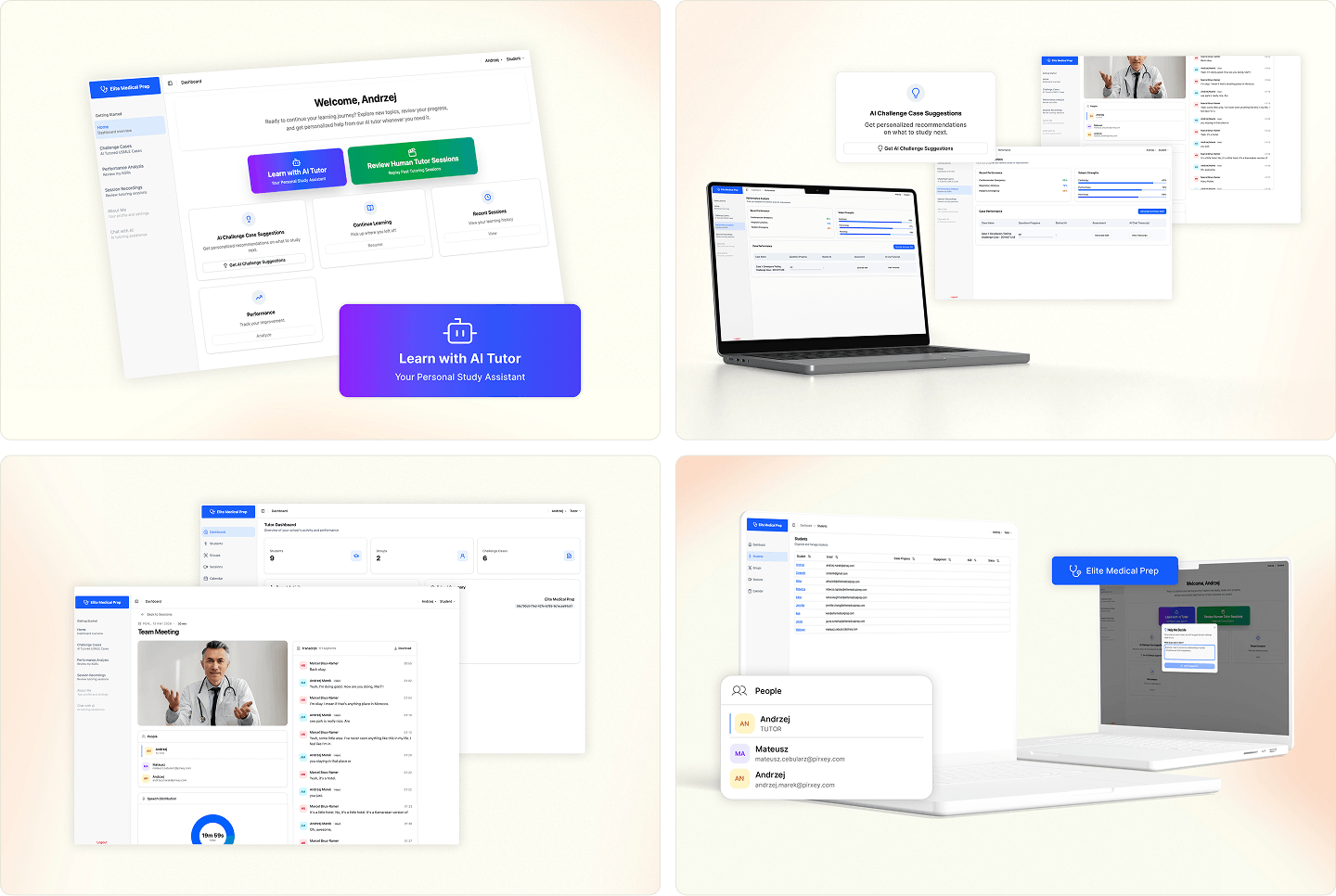
The result is a web platform with three distinct roles - student, tutor, and administrator - designed around the same Socratic model Elite Medical Prep tutors use.
- The core is the AI dialogue engine.
Students work through clinical cases and open-ended questions. The AI doesn't hand over answers. Instead, it first classifies what's actually happening: Is the student trying to answer? Asking for clarification? Demotivated? Completely off-track? Each state triggers a different response path. If they're close, it nudges. If they've hit a wall after several attempts, it shifts to a multiple-choice scaffold. If they're right, it confirms and advances. This decision tree runs before every single response. - The hardest problem wasn't building the AI - it was making it consistent.
USMLE questions have specific accepted answers. Free-text evaluation against medical criteria needs to return the same verdict every time for the same input. Early on, we designed an acceptance criteria layer: structured, AI-generated criteria that define what "correct," "partially correct," and "incorrect" mean for each question - editable by administrators, testable by the team. This gave Elite Medical Prep team control over how the AI reasons, and gave us a mechanism we could actually validate against. - We also built a performance reporting layer.
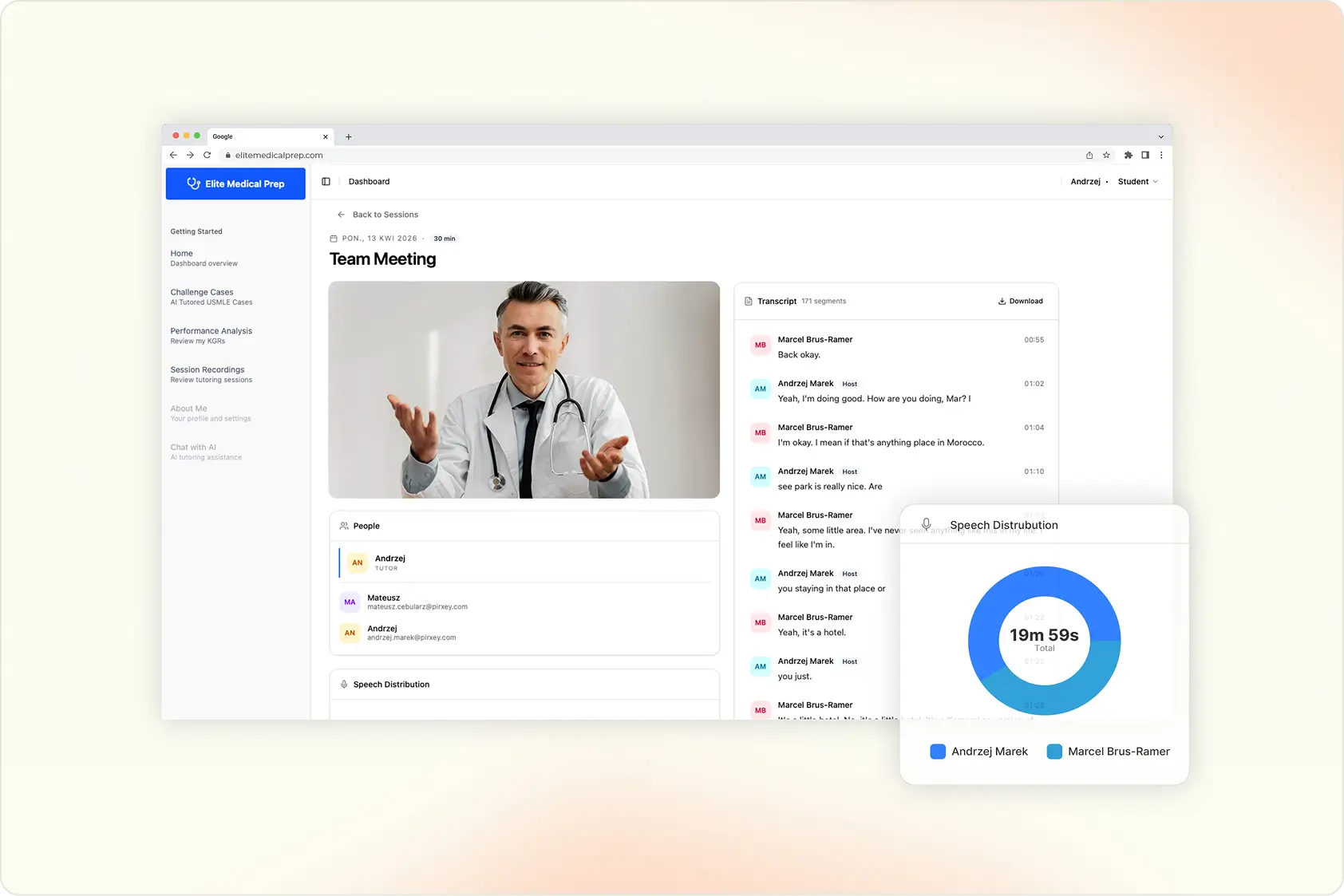
After each case, students see what they got right and where they struggled. Tutors see the same data as a structured report - designed to make their sessions more targeted, not to replace them. The long-term vision is a platform medical schools can white-label and run under their own brand, with their own students and their own content.
Over the course of the project, we ran roughly 100 working sessions with Elite Medical Prep - not status updates, but working calls where we translated medical domain expertise into software behavior, challenged assumptions, and made calls when requirements were ambiguous. The client brought the domain knowledge, we brought the structure. Neither side waited to be asked.
Outcome
A working product was delivered and deployed in approximately two months. The platform is live, in active use, and being refined iteratively with early users.
When asked what changed for the business, Elite Medical Prep was characteristically honest: "It gives us hope where we had none." The project was effectively dead before we came in. Now it has a working foundation, real users, and a clear path toward white-labeling for medical institutions.
On the potential scale: with AI handling routine components of tutoring, a single human tutor could support 4–5x more students than today - shifting from twice-weekly sessions to twice-monthly, while maintaining quality where it counts most.