Explore
Team augmentation · AI engineers

Bring AI engineering into your existing product team

Your product has an AI feature to build or fix, and the team needs someone who has built one before. Our engineers join your backlog and code reviews from 20 hours a week to work on retrieval, agents, model integrations, machine learning and evaluations. You interview the engineer first, there is no long-term contract, and the code, test cases and decisions stay with your product.

  • 130+People, remote across Poland
  • QA + productMost of our 2026 hires
  • 5.0Clutch rating, 11 reviews

This is for you if you need specialist capacity within your team

  • Search misses the records users need

    Answers sound confident and cite the wrong document. You need someone to check how sources are prepared and retrieved, with permissions that follow your users, then test every change against real questions.

  • A model change might break the feature

    A new model, prompt or provider looks better in a quick test. Your team needs a set of cases it can rerun before every change, so nobody finds out from users.

  • Cost and response time need attention

    Every model call has a price. The feature works, but someone has to measure cost and response time per request and find where the money and the seconds go.

  • The demo works, production does not

    An AI prototype or agent workflow stalled between the demo and real traffic. You want an engineer who picks up what exists, keeps what works and documents the rest in your repo.

What you get. AI capability inside your delivery team

An engineer you interview before they join

You talk to the person who would join, not a salesperson: their past work, a task from your backlog and the decisions your tech lead keeps. Add a trial task if you want one.

Reviewed contributions in your codebase

Retrieval, agents with clear decision points, model integrations or machine learning on your history, delivered through your team's review process with implementation notes alongside the changes.

Evaluation cases your team can rerun

Test cases your team can rerun before every model, prompt or provider change, with cost and response time measured per request. The engineer records the known limits before handing work over.

A program lead behind the engineer

A Pirxey program lead reviews the engineer's work and speaks up when there is a simpler way. If someone does not fit, replacing them is our job, not yours.

Terms you can change

From 20 hours a week, with the hours, overlap with your US day and a notice period agreed in writing. No multi-year contract. Hours are logged per task and visible to you.

People tested for how they think

Our engineers sit the CCAT, a cognitive aptitude test, when we hire them, and 80% of the crew score above the 90th percentile. AI writes more of the code now, so judgment is the part that matters.

Meet AI engineers from our team

  • 10+ years. Builds LLM applications and multi-agent systems with LangChain, CrewAI and AutoGen on OpenAI and AWS Bedrock, and runs them with LLMOps. Previously led a Data & AI practice.

    Mateusz

    Senior AI Engineer

  • Built a system that reads X-rays and MRIs with CNNs: anomaly detection, segmentation and reports. Also demand forecasting for logistics and an LLM product with voice sessions. MSc in theoretical physics.

    Kornel

    AI and LLM Engineer

  • 10+ years. Delivered generative AI in banking with Azure OpenAI, Semantic Kernel and Vertex AI, and works with GPT models and embeddings in Qdrant. Lead engineer of an AI product consultant.

    Bartłomiej

    LLM Engineer and Tech Lead

  • Built a modular system of specialized agents under central supervision, and call-center analytics with live transcription and anomaly detection on embeddings. Wired RAG into Jira automation.

    Patryk

    AI Agent Developer

Tech stack. AI tools chosen around the feature

Hosted models (Claude, OpenAI, AWS Bedrock, Azure OpenAI, Vertex AI) or open-weight models in your own cloud when data must not leave it. The work can be retrieval, agent workflows, classic machine learning for forecasting and scoring, computer vision and speech, or fine-tuning when a general model is not accurate or cheap enough. Tell us what your team already runs; we match the engineer to it, and your tech lead agrees the choices and data boundaries.

Tech stack

  • Python
  • Anthropic API
  • OpenAI API
  • AWS Bedrock
  • Azure OpenAI
  • Vertex AI
  • LangChain
  • LlamaIndex
  • CrewAI
  • AutoGen
  • Semantic Kernel
  • Vercel AI SDK
  • PyTorch
  • scikit-learn
  • Hugging Face
  • Ollama
  • Whisper
  • pgvector
  • Pinecone
  • Qdrant
  • Neo4j
  • Elasticsearch
  • LangSmith
  • FastAPI
  • TypeScript
  • PostgreSQL
  • Kubernetes
  • Claude Code
  • Cursor
  • Codex

How we work

Embed the skill in everyday delivery

You keep product direction and technical leadership. The engineer starts with one agreed task in your tools, and progress is reported in writing. Hours, overlap and the reporting rhythm are agreed before the assignment starts, with a notice period instead of a long-term contract.

Pirxey provides you the full package: you can ask for data experts, you can ask for AI experts, you can ask for frontend experts, and you have everything.

Shahar YahavCo-founder, SignalMesh
  1. Describe the gap

    The feature, what exists today, your stack, weekly hours and time zone. A few examples of where it fails help most. We reply within one business day and propose a matching engineer.

  2. Interview the engineer

    Ask about their past work and how they would approach a task from your backlog. These are company projects, so ask which parts they built and which decisions they owned. Add a trial task if you want one.

  3. Agree terms, then a first task

    At least 20 hours a week, the start date, overlap hours, data access and the notice period, written down before onboarding. Then a bounded implementation or evaluation task, delivered through your code review with the test cases or findings it produced.

  4. Review every month

    What shipped, the hours per task and how the feature performs on the agreed cases. Changes to hours or skills are agreed together, replacing someone who does not fit is our job, and your engineers keep the decisions and evaluation examples they need to maintain the feature.
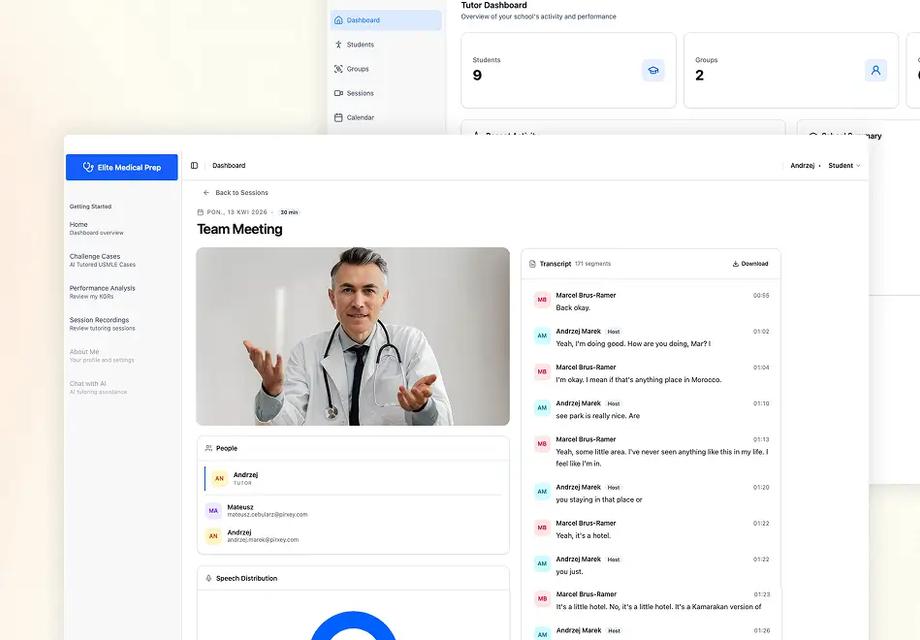

Proof, not promises

Featured
EdTech · AI
Elite Medical Prep · USA

AI-powered medical tutoring for Elite Medical Prep

2 mo broken codebase to deployed
Read
AI · FinTech
Signal Mesh · USA

Taking over a crypto platform no one else could ship

Questions about embedded AI specialists

  • No. Our engineers work in your repository, your backlog and your code review process, with the tools your team already uses.
  • With a 30-minute call about the role and the work. We propose people who fit, you meet them before they join, and the terms are agreed before work starts.
  • We confirm availability after discussing the work and introducing the proposed engineer. The start date also depends on access to your repo, data and tools. You meet the person before the assignment begins.
  • The minimum is 20 hours a week per engineer. We quote for the role and the weekly hours after the first call and agree the terms before work starts, with a notice period instead of a long-term contract. Time is tracked per task and visible to you; model and infrastructure costs are yours and shown separately.
  • Your team sets product priorities and your technical lead owns the agreed decisions. The engineer contributes through your backlog and review process. If you want a whole AI feature delivered under a separate scope, our AI integration service is a better fit.
  • By treating it like code that is hard to undo. Untrusted inputs and unacceptable answers go into the evaluation cases from the start, the agreed cases pass before a change reaches your users, and cost and response time are measured per request before they become your bill. Every change goes through your code review, and a Pirxey program lead reviews the engineer's work. This lowers the risk; nobody can promise a model never fails, and we say so.
  • No. Comparing approaches can be part of the assignment, and sometimes the answer is not an LLM: predictions from history are usually a machine learning job, repeatable decisions a rules engine or a decision graph, and some tasks are plain code. Your technical lead agrees the test cases and acceptance criteria before the engineer recommends one.
  • Yes. Work can focus on preparing the sources, retrieving relevant records or testing the answers. Representative questions and examples from your product help identify which changes are useful.
  • Only what you agree to. Before an engineer uses an AI coding tool on your code, we agree what it may see and which review rules apply. For AI features in your product, your tech lead approves data access and model use, and the engineer records the providers and dependencies used. Open-weight models in your own cloud are an option when data must not leave it.
  • The code, implementation notes and evaluation examples remain in your product environment. Reviews with your engineers cover the decisions and known limits they will need when changing the feature.
  • At Signal Mesh, our engineers built retrieval over thousands of posts, tested OpenAI, Claude and a third model, and configured three LLMs in production, plus an autonomous agent. The Elite Medical Prep tutor, deployed in about two months, runs on AWS Bedrock and OpenAI, with acceptance criteria the client's admins edit themselves. For Financial Trail, software for financial-crime investigators, we normalized more than 1.5 million records in a single case. In the interview, ask the engineer which parts they built.
  • Our team of 130+ engineers works remotely from Poland. Before the assignment we agree overlap hours with your US time zone and put them in writing, together with the reporting rhythm.

How we think about this, in our own words

Interactive briefs and articles by our team, picked for this service

Adding AI to your product: will it hold?

Whether an AI feature holds technically and financially under real traffic, the first question an AI engineer on your team has to answer.

Read the brief

Architecture is what the agent sees

How architecture limits what an agent or a model-powered feature can touch in your product.

Read the brief

AI Agents Are Not Just Changing Tools. They Are Redefining Accountability

Who is accountable once an AI agent executes work in your product, and where human approval belongs.

Read the article

Identify the AI work your team needs help delivering

Additional details (optional)

We reply within one business day.

Pirxey will process your data to answer your inquiry. Details in our Privacy Policy.