
 3 min read
Launching a new product shouldn’t feel like tossing cash into space. Yet many startups light the fuse, burn through weeks of work and budget, and never learn if anyone even wants what they built.
That’s where an MVP (Minimum Viable Product) comes in. A Minimum Viable Product is the smallest, test-ready version of your idea, just enough features to see if real users bite, nothing more.
Step 1 - Pinpoint the Core Problem
Your first job isn’t writing code. It’s spotting one painful problem that real people face every day. If you can’t say it in a single sentence, you don’t know it well enough yet.
Start simple:
- Write down the problem in ten words or less.
- List who feels that pain the most.
- Ask those people how they solve it today (or if they bother at all).
If their answers wander or sound polite, the pain may be too small. Keep digging until someone says, “I’d pay for that right now.”
Step 2 - Draft a 5-Screen Prototype
You know the problem. Now sketch the simplest way to solve it - no code, just screens.
Think of your prototype like a comic strip:
- Home/entry point – where users land.
- Action screen – the place they do the one key thing.
- Result screen – shows the outcome or value.
- Error/empty state – proves you planned for “oops.”
- Next step/upsell – hints at what full product could become.
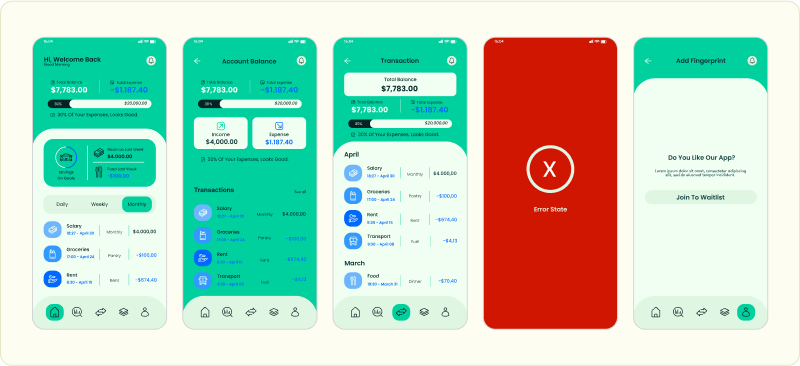
Source: Finance Management Mobile App UI UX Kit for Budget Tracker Financial Prototype Design (Community)
Five screens max keeps you honest…
If you need more, you’re stuffing extra features in.
- Use Figma (free tier is fine).
- Stick to grey boxes and plain text. Colors and logos can wait.
- Add quick comments to explain each click.
Show this click-through to the same users from Step 1. Watch where they hesitate or ask, “What happens here?” Those moments are gold. Fix them before any developer touches a keyboard.
| Tip: Keep every screen under 30 words. If you can’t explain it briefly, the flow is too complex. |
|---|
Step 3 - Validate With Real Users (Before a Single Line of Code)
Your five-screen demo is ready. Now you need proof that strangers - not just friends will use it.
Run three quick tests
1. Five-User Walk-through
Jump on a 15-minute call, share your screen, and let them click.
- Say nothing except: “Tell me what you expect next.
- ”Note every pause, every “huh?”—those spots need fixing.
2. Landing-Page Smoke Test
Create a one-pager in Carrd or Webflow.
- Headline = the core problem; CTA = “Join the beta.”
- Spend $50 on targeted ads or drop the link in a niche Slack/Reddit.
- Ten real sign-ups in a week? Strong signal. Zero? Rethink.
3. Price-Sensitivity Ping
- Ask sign-ups: “Would you pay $X/month for this?”
- Watch for clear yes/no, not polite maybes.
What you’re looking for
- Users finish the flow without coaching
- At least a few say, “I need this now.”
- Someone is willing to trade email, time, or dollars.
If none of that happens, good news - you just saved months of dev work.
| Tip: Record every session (Loom, Zoom) and re-watch at 2× speed. Patterns pop out fast, and your team can learn without attending every call. |
|---|
Step 4 - Build Only the Rocket Engine
Time to code - but just the parts that make the core flow work.
Strip the scope to bare metal
| Feature | Need it to test? |
|---|---|
| One main user action | ✅ Keep |
| Simple data store (spreadsheet, Firebase, Supabase) | ✅ Keep |
| Basic auth (only if data is personal) | ✅ Keep |
| Fancy dashboard, dark mode, chat, analytics, notifications | ❌ Park for later |
| Payment gateway (unless pricing is the test) | ❌ Park for later |
Keep the build fast and simple
- Pick a quick stack. Next.js + Supabase, Rails + SQLite, or even no-code (Bubble, Glide).
- Code the happy path first. Success state → confirmation → done.
- Handle one error. Everything else can show a polite “Oops, try again.”
- Write tiny unit tests for the mission-critical function. Skip the rest for now.
Step 5 - Launch to a Tiny, Targeted Audience
A finished engine is useless on the ground. Get your MVP into orbit—just not the whole galaxy yet.
Who gets first boarding passes?
- 10–50 users who match your earlier interviews
- People reachable in one click (Slack channel, Discord, newsletter segment)
- Folks willing to give feedback within 24 hours
Soft-launch playbook
- Send a personal invite - “We built a 5-screen test for the problem you mentioned. Try it? Takes 3 min.”
- Provide a friction-free link - No sign-up walls unless privacy demands it. The easier the entry, the clearer the data.
- Stay online while they test - Use Intercom or even WhatsApp. A quick “How’s it feel so far?” reveals hiccups instantly.
Collect three numbers only
- Activation rate (finished the core action)
- Time to value (minutes from landing to “aha”)
- Repeat visits in 7 days
More metrics now just create noise.
What success looks like
| Signal | Meaning |
|---|---|
| ≥ 40% activation | Problem resonates; flow is clear |
| Users return unprompted | Value beats curiosity |
| At least one user asks, "When can I pay?" | Strong buying intent |
No fireworks? Iterate one variable at a time (copy, order of steps, incentive) and rerun the test.
Step 6 - Measure, Iterate, or Pivot
Your MVP has been in the wild for a week or two. Now comes the moment of truth: keep going, tweak it, or change course.
Read the numbers first
| Metric | 🟩 Green flag | 🚩 Red flag |
|---|---|---|
| Activation rate | ≥ 40% | < 25% |
| "Aha!" time | < 3 min | > 5 min |
| 7-day return rate | ≥ 20% | < 10% |
| User messages ("Can I pay?") | ≥ 1 | 0 |
If you’re mostly green, great – double down on what works.
Decide with a quick “Flight Log” meeting
- What did users love? - Keep or deepen it.
- Where did they stall? - Fix copy, flow, or tech bugs—one change at a time.
- Is the core problem still real? - If feedback shows indifference, the pain might be smaller than you thought.
- Do we add a feature or simplify further? - Only if it helps test the same hypothesis faster.
Three clear paths
| Path | When to choose it | Next move |
|---|---|---|
| Improve | Metrics trending up but not solid yet | Tweak copy, shorten flow, retest in 7 days |
| Scale | Activation & retention strong, users ask to pay | Add payments, invite 10× more users, prep marketing |
| Pivot / Scrap | Low interest after two iterations | Go back to Step 1 with a new problem or audience |
Once you have data and a decision, you’re no longer flying blind.
That’s how a lean MVP saves months of burn and points your startup toward real orbit or safely back to the drawing board before any serious damage is done.